as per julie's suggestion here, i did the political spectrum quiz. this is my result:
My Political Views
I am a left moderate social authoritarian
Left: 6.87, Authoritarian: 1.32
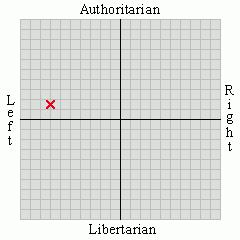
Political Spectrum Quiz
hmmm, i'm only just an "authoritarian" but definitely a lefty. i'm not sure that this really reflects who i am, and i found several of the questions difficult to answer. but there it is.
ETA: didn't have time before this post went up (busy doing the down under feminists carnival!) but wanted to link to this post on tensions between class and democratic reform at kiwipolitico. says what i've been trying to, only better.
i caught up with a friend over the weekend, whom i hadn't seen in a while. the reason being that she's shifted up to auckland & is working in one of the top accounting firms there.she started telling me about her workplace, and i'm truly appalled. she tells me that she has often been working until 10pm at night, and staying until 9pm is normal. this is the expectation of all employees. i asked her what would happen if she refused, and left work around 5.30pm. she said that the result would be that she would be allocated the most boring jobs that would give no satisfaction, and it would mean that she wouldn't be moving up within that organisation.there is no doubt that this particular firm is getting at least 1.5 person's work out of 1 person, and that they are doing so deliberately. my friend says that staff turnover is high, but with the current recession, people are not able to leave so easily. and because it is so difficult to get a position in what is seen as a prestigious firm, these young people don't want to let that position go because of the fear of the negative effect on their career.this pressure appears to be applied to new graduates, and of course the accounting workforce isn't unionised (not that i've seen, anyway). we have the institute of chartered accountants, but i've never ever heard of them fighting for the rights of junior staff to have decent work hours. it's not likely, given that the elected positions in the institute are mostly senior partners in accountancy firms.at least these graduates are getting paid a better wage than, say, cleaners on contract & unlike cleaners, they know that if they stick it out, they'll be getting promoted. but that doesn't make this kind of exploitation right. these big firms are working in a competitive market, and the way they keep the price to the client down is by saving on labour costs.i wish i could name the particular firm, but i don't want to get my friend in trouble and don't want to end up with any kind of legal action against myself. but really, the only way to deal with this kind of thing is by naming and shaming. and getting these young people to join a union.in other news, my friend and hamilton city councillor daphne bell has just joined the blogoshpere. welcome daphne, and looking forward to your contribution.
i've been thinking about whether or not to put up an open letter from the christian peacemakers team in palestine, but after hearing this:Just days after President Obama called for a complete freeze on settlement construction, the Israeli government authorized construction on 300 new homes to be built in an "illegal outpost" in the West Bank. An illegal outpost: that's a settlement that's illegal even according to Israeli law. 60 totally illegal houses, and roads to get to them, have already been built in this outpost. Instead of demolishing it - which is what they should do - the Israeli government is performing a whitewash that will make this whole outpost a "legitimate" settlement.*i thought it was worth sharing. so here is the open letter in full:Dear President Obama,On Tuesday June 15th, you said of the protests in Iran, “When I see peaceful dissent being suppressed, whenever that takes place, it is of concern to me and it is of concern to the American people.” For the last 13 years, Christian Peacemaker Teams have witnessed the brutal suppression of peaceful dissent here in Palestine. In the city of Hebron and the village of At-Tuwani, CPT supports vibrant Palestinian non-violent resistance to Israel’s military occupation. Every day, Palestinians hold non-violent demonstrations and defy curfews and closed military zones. They rebuild demolished homes and work their land despite the threat of arrest and attack. Though their struggle is largely ignored by the media, we find inspiration in the way Palestinians are working for justice and peace.We are deeply troubled by the way Israeli authorities respond to this non-violent resistance. On April 22, 2006, Israeli police beat and arrested the mayor of At-Tuwani village and his brother for doing no more than holding a peaceful demonstration against the illegal Israeli wall. CPT has documented the Israeli army demolishing the homes of non-violent resistance leaders, harassing them at checkpoints, and targeting them for arrest.Too often, Israeli forces respond to non-violent resistance with lethal force. In the past nine months, Israeli soldiers have killed four residents of the village of Ni’lin during demonstrations against the Israeli wall. Ahmed Mousa, age 10, was shot in the forehead with live ammunition on July 29, 2008. Yousef Amira, 17, was shot twice with rubber-coated steel bullets in next day. On December 28th 2008,22-year-old Arafat Rateb Khawaje was shot in the back with live ammunition. The same day, Mohammed Khawaje, 20, was shot in the head with live ammunition. On March 22nd 2009, American demonstrator Tristan Anderson was shot in the face with a tear gas canister. He still lies in the hospital in critical condition. Each of these incidents raises a simple question: why do Israeli soldiers respond to unarmed protestors with deadly force?When Israel arrests, attacks and kills Palestinians who practice non-violent resistance, it is saying to the Palestinian people, “No matter your methods of struggle, no matter the justice of your cause, we will not share power with you.” In this context, it is a grave mistake to call, asyou did in your Cairo speech, for Palestinians to abandon violence without calling on Israel to do the same. To speak as though there is no Palestinian non-violent resistance movement is worse than naïve; it gives Israel permission to continue to ignore their cries for justice and freedom.In his recent speech, Israeli Prime Minister Benjamin Netanyahu outlined his conditions for peace with Palestine. He described a future Palestinian state that would not be a state at all. Its borders and airspace would be controlled by others. It would be demilitarized while Israel remained free to continue building a nuclear arsenal. This is not a plan for peace. It is a demand that Palestine submit to Israeli domination.As Prime Minister Netanyahu makes these demands, his government continues to suppress Palestinian non-violent resistance. Unarmed demonstrators inN’ilin are still met with tear gas and live bullets. In Hebron andAt-Tuwani, children on their way to school are still attacked by Israeli settlers and settlements continue to grow. We ask you, President Obama, to demand that Israel stop its campaign of violence against the Palestinian people. We echo the Palestinian non-violent resistance movement’s calls for justice and human dignity. Only justice will lead to peace.
In Hope,Christian Peacemaker Teams-Palestine*i got this by email from "jewish voices for peace", don't have a link
i've got a short post up at the hand mirror today, regarding activism against cuts to community education. i'll have another short one up tomorrow about the provocation defense being used in the sophie elliot murder case.
i did a little spot on radio nz's the panel this afternoon (right at the end of the clip). it was regarding a discussion about the killing of neda soltani during the recent protests in iran. her dying moments were caught on camera and put on youtube, and have now been viewed by millions around the world.i'm not going to link to the clip here, i couldn't bear to watch it myself. i agree with rosemary mcleod's comments that there is something inherently wrong in putting a video of someone's death into the public sphere in this way. there was no question of her consent having been obtained, and there is no doubt that this video is being used as a political tool.which is not to say that people should remain ignorant of the effects of violence and the suppression of political dissent. and in a way, the current spotlight on the protests has changed the narrative around the iranian people. many in the west are now beginning to identify with them, to see the humanity and the commonalities. they are becoming less and less the evil "other".in that regard, the reports filed by jason jones on the daily show have been pretty amazing. i've been watching the last two nights as he has gone into an iranian home to do an interview, and he has interviewed iranians who have subesequently been detained by the current regime. while he has generally behaved like an ass, which he usually does, he shows us that these are just people like us but involved in an extremely difficult struggle.i don't see any great outcome for iran at present. i hope the country doesn't fall into civil war. i have no great faith in mr mousavi, who even mr obama thinks is not too much different from mr ahmedinejad (and the evidence appears to support that view). if he plans to make substantial reforms, he will be behaving quite differently to when he was last in office, and i find it hard to believe that he's offering more than just words.and when he uses the phrase "an alms-based economy", it reminds of national party rhetoric about working for families turning people into beneficiaries. it's so typical of right-wing arguments against any kind of state support for the less well-off, and is just a sham excuse for for inaction on poverty.on the other hand, there is no doubt that reform is required in iran in many areas. the response of the current regime to the recent protests is appalling. the fact is that they are floundering and don't know how to deal with the situation, so have fallen back on suppression.and neda soltani got caught in the crossfire. i admire her courage in standing up for what she believed, in a particularly dangerous situation. if there is any silver lining to be gained from her death, it's that she has managed to narrow the gap between east and west. she has ensured that we no longer remain indifferent to th plight of the iranian people. may she rest in peace. inna lillahe wa inna ilaihi raji'oon.
i've had a post up at the hand mirror today, about the furore raised by a aussie green party MP who brought her child into the house for a brief period.also of interest today was this excellent discussion on radio nz (nine to noon, 9.22am) about disparities in public health care between maori and non-maori. i thought the way the issue was framed was really good, not casting aspersions at health professionals but rather explaining why they might behave in certain ways.it's so important to have this discussion, because people who do not face this kind of thing so often refuse to believe it exists at all. they seem to believe that everyone has equal access to every service in this country, but can't see how certain behaviours or assumptions might act as a barrier for minority groups.there are ways to deal with this issue, and the immediate one is to have maori provide services for maori, pasifika people provide services for their own and ethnic communities provide services for their own. that's the reason for the development of the ethnic women's centre in hamilton - the desire to provide an environment where women feel safe and free from discrimination, so that they are able to talk about their issues and get the help that they need.one of the problems with this approach is that it does lead to a kind of "apartheid", where communities become separated from each other. which means they are even less likely to understand each other, and hence overcome the disparities that exist in service delivery. on the other hand, there is no way that a cultural change with existing institutions will happen overnight, and in the meantime there are people suffering and unable to access the help they need. so in the short term, the separate providers is a good idea.in the long-term, there needs to be effort put into creating that cultural change, so that all people are able to receive the same level of service and can feel safe and confident in every environment. in order for that to happen, there first needs to be an acknowledgement that there is a problem that needs to be solved. hence the importance of this particular research and the discussion around it.
so, still trying to keep my head above water. i got 3 things done out of the 100 in my (after-paid-employment) in tray. which is better than the zero things i got done in the last week, i suppose. also managed to catch up with an old family friend, who migrated from nz many years ago.this is one thing i find frustrating about nz. it's a small country, and people move in and out of it so much. i guess it's especially true of hamilton, where there are not so many high-powered jobs to be had. so people who are wanting to move up in the world need to move away.it's something i find really frustrating. making friends is like making an emotional investment in a person, and to have that person then leave your life is often a very painful loss. i guess that's part of the modern lifestyle, with close family members spread around the world, and your own kids not likely to be living in the same country as yourself.i can think of so many people that i've been close to, and who i still miss. because i'm totally slack at keeping in touch, the contact remains just a memory in my mind. yes, i know this is what facebook & other social networking sites are for, but i really haven't got into that yet.i'm really not one who looks back to the "good old days" with any particular fondness. many aspects of modern life seem to be so much better than what we had in the past. progress and technology are generally good things. but this is one area where i prefer the past, when international travel (and even national and local travel) were a difficult thing, and people uprooting and leaving didn't happen so much. there was a time when you'd be born in a village and your children would be born there, and so would your grandchildren. and all the people you cared about would be close to you for most of your life.of course, there would be too high a price to pay for going back to that time and i know that people then had other things to worry about, like high infant mortality rates, high rates of death during childbirth, plagues and the like. so if you weren't losing your dear ones in one way, then you were losing them in another.there is the possibility that climate change will force us to travel less, what with peak oil and carbon footprints. but human beings are an inventive species, and i'm sure someone will work out another method for getting from A to B in an environmentally way. then there is the possibility of space travel, which means that distances won't just be inter-continental, but inter-planetary. i hope that doesn't become a reality in my lifetime!end of ramble, this is obviously a lazy post cos i'm not up to doing much else right now. but to all of my overseas friends and family, i do think of you often and miss you a lot. i wish you'd stayed here.
i'm still being troubled with my health, meaning i'm not sleeping too well plus can't seem to shake the cough i've had for a couple of weeks. hence i'm falling behind with all my non-paid-employment work. i'm wondering at this stage how i apply for annual leave from all of that, when i know others are depending on me. sigh. i'll think about it tomorrow.in the meantime, i've put up a short post at the hand mirror to belatedly mark world refugee day.and i'd like to reproduce a press release which i can't find on the internet from the migrant action trust, who do some wonderful work:Migrant forum demands immediate action from the government.More than 160 migrants attended a forum organized by the Migrant Action Trust on Saturday 30 May at the Windy Ridge Primary School on the North Shore. The Trust is a community organization that works on behalf of migrants.Migrant participants of the forum made it clear that their priority as residents and workers in Aotearoa/ New Zealand was to contribute to New Zealand society and for New Zealand to acknowledge and value the contribution that migrants make to the economic and social fabric of the country. The migrants, representing a variety of countries but predominantly Filipinos and South Africans, were adamant that they did not wish to hold second class status in New Zealand.The forum participants were in general agreement about the failure of the government to have a comprehensive and clear plan around migrant employment particularly the Work to Resident Proposal says the Trust’s Chairperson, Dr Camille Nakhid.She further stated that the primary concern to the migrants was that they had been invited by New Zealand to apply for employment and residency in order that their skills and expertise could be used. On arrival here, they have found that employment conditions were less than ideal and New Zealand now had to hold its immigration department and employment institutions accountable for the adverse ways that migrants are treated. The situation is especially disconcerting for those migrants that gave up good employment opportunities and occupations in their home country to migrate here. The migrants want the government to realize that in the current economic climate, finding a job takes longer than expected even for New Zealand citizens. One of the migrants present who moved from a student permit to a work permit must find a job within 12 months, an unrealistic goal in these times. A number of migrants also lamented the fact that they had been invited to apply for permanent residency only to be made redundant and the exorbitant legal fees that they incurred in having to change their visa status.Participants also told the two Members of Parliament present at the forum that immigration officers often provided incorrect and contradictory information and that there was inconsistency in the way that applications were being processed by immigration officials. The migrants claimed that they found the details in the immigration documents misleading and this was exacerbated by their encounters with unethical immigration consultants.Pacific migrants were also concerned at their labour segmentation in the market place and the government’s discriminatory immigration policies of employing Pacific nations people to fill low wage and unskilled occupations.Many migrants had been deeply offended by the Minister of Immigration Jonathan Coleman’s remarks which they said demonized migrants and allowed employers to discriminate against them in the workforce. They are calling on Mr. Coleman to retract his statement and to review his proposal to not renew or issue further work permits.
i've been only vaguely been keeping up with the news of protests in iran against the outcome of the recent elections. i've seen the protests, felt very sad at the number of deaths and am disappointed that there has been election fraud.one of the most interesting things about modern protests in any countries is the role of technology. with mobile phones that allow txts, photos, video, and tweets to be sent from right in the middle of the action. then there's the internet with blogs, email etc to provide yet more information. if it's not censored that is.but one issue that arises from all of this is whose voice we hear are those from the upper class, or middle class, or at least not the really poor - since most people in most countries can afford a mobile phone, though not possibly ones that can be sending video images. but computers are usually not so accessible to the really poor. and in non-english-speaking countries, the poor generally don't speak english.the result is that the voices we predominantly hear are those of the relatively wealthy. in fact this is common to any country. poor people here have less of a media voice than those with more money. it's the lack of education and writing skills, along with a lack of knowledge of how to use the media, and not being as articulate in terms of putting their points of view forward.which means that we tend to get a one-sided view. this is more likely to be the case when it comes to another country. and it can become dangerous if those with a greater voice are advocating positions that will adversely effect those who don't have that same access to technology.i'm not saying that i support mr ahmadinejad, nor do i support rigged elections or political suppression. but i'd like to see more balance in the people we get to hear from. on any issue, in any country.
no post yesterday, as i took my doctor's advice and had a rest. and here is the post regarding the difficulties in finding a woman doctor.i also have a post up tonight regarding the stoush between david letterman and sarah palin.


